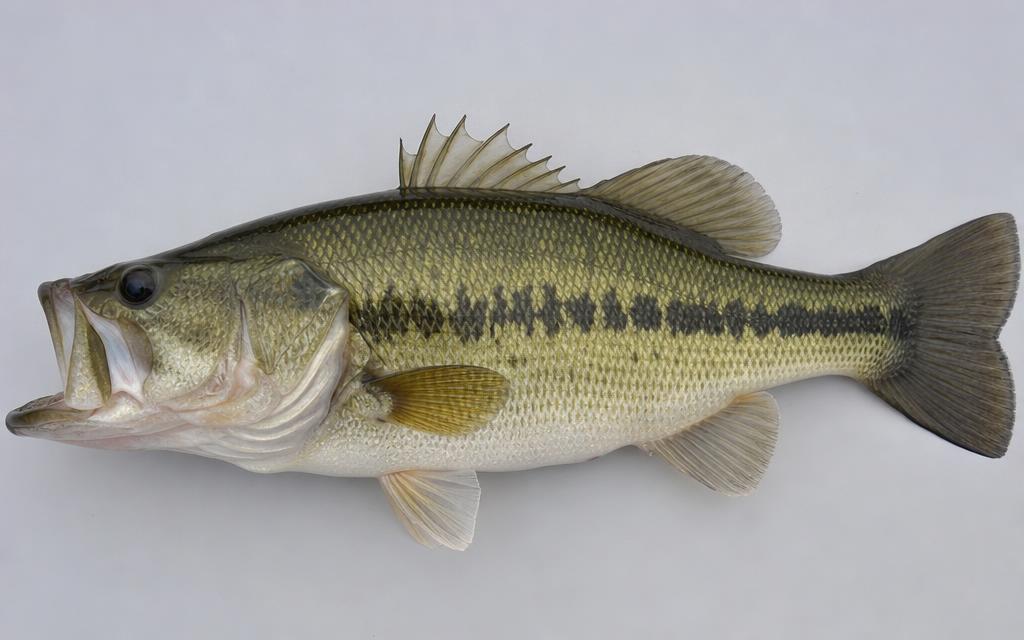
Largemouth Bass
Micropterus salmoides
- Identify
- Huge bucket mouth extending past the eye; dark blotchy stripe down the flank; deep notch between dorsal fins.
- Where
- Lake Martin, Yates and Thurlow, Chewacla State Park lake, and the Saugahatchee Creek arms — around laydowns, docks and grass edges.
- Bait
- Live shiners under a float
- Green pumpkin Texas-rigged worm
- Chatterbait or spinnerbait in stained water
- Topwater frog over pads at dawn
- Hooks
- 3/0–5/0 extra-wide-gap worm hook; 4/0 straight-shank for flipping jigs.
- Rig
- Texas rig with a 3/16 oz tungsten weight, or a shaky head on cleaner banks. Carolina rig for deep summer points.
- Line
- 15–20 lb fluorocarbon on baitcaster; 40 lb braid with a fluoro leader in heavy cover.
- Eating
- Firm white meat, but Alabama bass anglers mostly release bigger fish. Keep 1–2 lb fish; skin the fillets and remove the red lateral meat for a cleaner flavor.
- Legal size
No statewide minimum on most Auburn-area water. Local exceptions apply: Harris Reservoir protects 13–16 in fish, Lewis Smith 13–15 in, Lake Eufaula has a 14 in minimum.
Daily limit: 10 black bass per day (all species combined). Measured by total length, mouth closed, tail pinched.
Keep
12–15 in (about 1–2 lb) — the best eating and the most abundant year class.
Throw back
Anything over 4 lb. Big Alabama largemouth are almost always females carrying the next spawn, and the meat is coarse. Photo and let her swim.
Caught at these spots
Jump straight to the pin on the spot map.
Best months
Peak bite Good Slow
JJan
FFeb
MMar
AApr
MMay
JJun
JJul
AAug
SSep
OOct
NNov
DDec
Prespawn March through April is the best shot at a giant; October's shad migration is the best shot at numbers.
- Tide / current
- No tide, but current matters: on Yates and Thurlow the bite turns on when Alabama Power starts generating and water begins pulling past points and rip-rap.
- Best time of day
- First light to about 9 a.m. and the last two hours before dark. In winter, the warmest part of the afternoon is actually best.